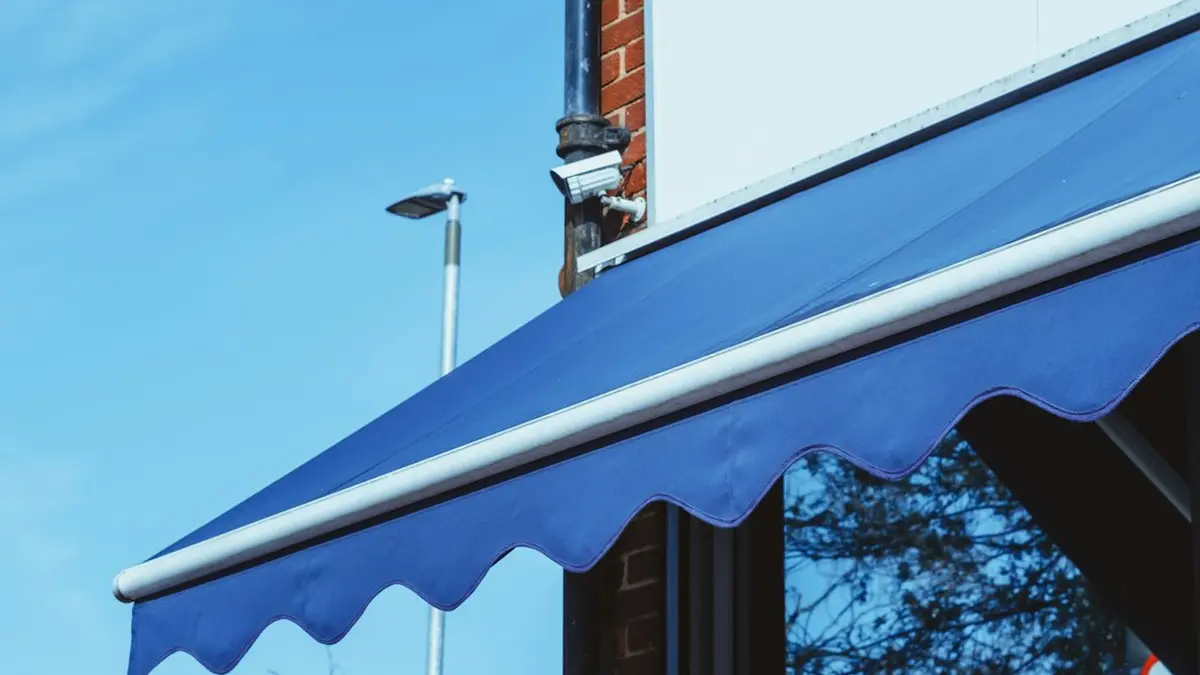
An awning is a fabric or metal cover that shades a patio, deck, window or door. Most awnings are fixed to the house wall. Some stand on their own posts. This page is for US and UK homeowners who want to know which type fits their space and what it costs installed, before they ask for a quote. It sorts awnings by how they mount and how they open. It prices each type from cost guides and makers' price lists dated 2026.
The figure most buyers get wrong is the price. The price on a product page often covers the unit alone. Marygrove's 2026 cost guide reports that professional installation adds $800 to $2,000. It reports that wall reinforcement on stucco or brick adds a further $200 to $600. Compare installed prices, not unit prices.
How each kind of awning is built
Awnings fall into three groups by how they are held up and whether they move.
- Retractable: wall-mounted arms extend the cover and fold it away.
- Fixed (stationary): a frame and cover stay in place all year.
- Freestanding: the awning sits on its own posts and does not need the house wall.
Yisite Pergola (undated) states that a wall-mounted awning needs a structurally sound exterior wall. It states that a post-supported structure needs base anchoring or footings.
| Fact | Retractable | Fixed aluminum | Freestanding |
|---|---|---|---|
| Typical installed price (Angi 2026; CurrentCost 2026; Awning San Diego 2026) | $1,000 to $3,500 for most homeowners (Angi) | $1,000 to $2,600 for mid-range sizes (CurrentCost) | $1,000 to $5,000 for stand-alone shade structures (Awning San Diego) |
| What holds it up (Yisite, undated) | Exterior wall | Exterior wall | Its own posts, on anchors or footings |
| Cover (CurrentCost 2026; Yisite, undated) | Fabric | Solid aluminum | Fabric, or beams or louvers on pergola-style units |
| Folds away (Yisite, undated) | Yes | No | No |
| Lifespan (Rollac 2026; CurrentCost 2026; Yisite, undated) | 10 to 15 years, up to 20 with care (Rollac) | Not stated; a solid cover needs replacing less often than fabric (CurrentCost) | Not stated for shade structures; 15 to 25+ years for maintained aluminum pergolas (Yisite) |
Retractable awnings by housing
A retractable awning is sold in one of three housings. The housing decides how well the rolled fabric is protected when the awning is closed.
- Open or folding lateral arm: the arms fold against the wall and the fabric rolls onto a bar. Awning San Diego prices folding lateral arm awnings at $1,500 to $4,000 (2026).
- Half-cassette (semi-cassette): a cover sits over the rolled fabric. Awning San Diego prices half-cassette units at $1,200 to $4,000 (2026).
- Full cassette: the fabric and arms close into a weather-proof housing. Marygrove prices motorized full-cassette awnings at $5,000 to $8,500 (2026). It lists LED lights and wind sensors on these units and a lifespan of 12 to 15 years.
Retractable awnings by operation
- Manual: opened and closed with a hand crank.
- Motorized: opened by push button or app. A motor needs a power supply.
- Smart: a motor plus automation. Marygrove lists voice control, automation and sun tracking for this tier.
Prices for each are set out in the price section below. The sources disagree on them by several thousand dollars.
Drop-arm and vertical awnings
A drop-arm or vertical awning hangs down over an opening rather than projecting out. Rollac prices vertical awnings at $700 to $8,000+ (2026). Awning San Diego prices solar or drop-down shades at $500 to $2,000 (2026). None of the sources gives a separate price for drop-arm window awnings.
Window and door canopies
These are small awnings over one window or one door. 2026 prices:
- Single window awning: $250 to $700 (Awningtown).
- Window awning: $800 to $1,400 (Rollac).
- Door awning: $300 to $800 (Rollac).
- Door or window awning: $350 to $900 (Awning San Diego).
Fixed, dome and slope awnings
CurrentCost prices fixed aluminum awnings with solid covers at $1,000 to $2,600 for mid-range sizes (2026). The Homewyse benchmark is a sloped fabric awning. None of the sources gives a price for dome awnings.
Freestanding and large-span awnings
Awning San Diego gives these 2026 ranges:
- Stand-alone shade structures: $1,000 to $5,000.
- Pergola-style awnings: $2,500 to $8,000.
- Large roof awnings: $3,000 to $10,000.
Materials
The cover and the frame are priced separately.
- Acrylic fabric: $1.50 to $5.50 per square foot, about $16 to $59 per square meter (Angi, 2026).
- Solution-dyed acrylic: lasts 10 to 15 years and costs about $15 to $40+ per linear yard (Awningtown, 2026). Marygrove gives 12 to 15 years for solution-dyed fabric.
- Budget polyester: about 3 years (Marygrove, 2026).
- Vinyl (PVC-coated polyester): 5 to 8 years (Awningtown, 2026).
- Knitted HDPE mesh: sold with a 15-year warranty at about $30 to $200 per roll (Awningtown, 2026).
- Aluminum frame: $400 to $2,000. Angi states that aluminum is the standard frame, and that steel and decorative frames cost more (2026).
- Polycarbonate: none of the sources gives a price or lifespan.
Rollac states: "Metal or aluminum awnings are usually more expensive than fabric options, and the type and quality of the fabric used can also impact the price." To compare fabrics on UV block, fading, water and lifespan, use the outdoor shade fabric comparer.
Choosing and pricing an awning, in order
-
Tape measure
For the wall width and the depth of shade needed.
-
The direction the wall faces
From a phone compass or the sun.
-
The wall material
Concrete, solid brick, brick veneer, stucco or siding.
-
How exposed the site is
Sheltered, a corner, coastal or hilltop.
-
Whether there is an outdoor power supply
Needed for a motorized awning.
-
A budget that includes installation, permit and any wall work
Not the unit price alone.
-
Find which way the wall faces
Use the garden aspect finder to find the wall's direction and the hours of sun it gets in each season. When this has worked, you know the hours of the day the awning must shade.
-
Measure the width and the projection
Width runs along the wall. Projection is how far the awning reaches out from it. Write both in feet and meters. Riser Shade (undated) states that an 8 ft (2.44 m) projection handles wind better than a projection of 12 ft (3.66 m) or more, because the larger area catches more wind. When this has worked, you have a width, a projection and an area in square feet.
-
Check the wall that will carry it
Progolas (undated) states that a high wind rating is only valid when the awning is anchored to concrete or solid brick. If the wall is stucco or brick that needs reinforcing, budget $200 to $600 (Marygrove and Rollac, 2026). If new mounts or masonry work are needed, Angi gives $500 to $3,000 (2026). When this has worked, you know whether wall work goes into the quote.
-
Choose the type and housing
Use the comparison above. If the awning must fold away, choose retractable. If the fabric needs protection when closed, choose a half-cassette or full cassette. If there is no suitable wall, choose freestanding. When this has worked, you can name the product type on a quote request.
-
Choose manual or motorized
If you choose a motor, an electrician may be needed for the hookup. Rollac gives $200 to $500 for this (2026). Homewyse's benchmark unit has an electric motor with manual override. When this has worked, you know whether the quote must include electrical work.
-
Choose the fabric
Compare lifespan as well as price. Budget polyester lasts about 3 years and solution-dyed fabric 12 to 15 years (Marygrove, 2026). When this has worked, the fabric is named on the quote.
-
Choose a wind rating and sensor
In the UK, ask for the EN 13561 wind class (see the rules section below). Riser Shade gives $150 to $200 for a vibration sensor and $250 to $350 for an anemometer station that measures wind speed (undated). When this has worked, the quote states the class or rated wind speed, and whether a sensor is included.
-
Estimate the installed cost from the area
Multiply the area by a per-square-foot rate. Angi gives $15 to $30 per sq ft installed (2026). Homewyse gives $18.26 to $25.40 per sq ft (May 2026). The worked example below shows the arithmetic. When this has worked, you have a price range to test quotes against.
-
Get quotes and check each line
CurrentCost breaks the installed price into materials at $8 to $11 per sq ft, labor at $6 to $9, job supplies at $2 to $3, and equipment and disposal at $1 to $2 (2026). If a general contractor manages the job, Homewyse adds 13% to 22% for overhead. When this has worked, every quote shows the awning, the labor and any wall or electrical work as separate lines.
-
Apply for a permit if your area needs one
Homewyse's estimate excludes permits. Angi gives permit fees of $150 to $250 (2026). Awning San Diego gives $25 to $100 (2026). When this has worked, you hold the permit before the install date.
-
Have it installed
Rollac gives 2 to 4 hours for a standard installation (2026). Awningtown gives $100 to $400 for labor on a manual awning, and up to about $1,000 on a motorized one (2026). When this has worked, the awning opens and closes fully, and the sensor retracts it on test.
Pricing a 10 by 12 ft retractable awning
Say the wall takes an awning 12 ft (3.66 m) wide with a 10 ft (3.05 m) projection. The area is 120 sq ft (11.1 sq m). Homewyse's May 2026 rates are used, with Angi's 2026 permit fee range.
| Area | 120 sq ft (11.1 sq m) |
|---|---|
| Installed cost at $18.26 per sq ft (low) | $2,191 |
| Installed cost at $25.40 per sq ft (high) | $3,048 |
| Permit fee (Angi) | $150 to $250 |
| Subtotal | $2,341 to $3,298 |
| Add 13% to 22% if a general contractor manages it | $2,645 to $4,024 |
| Angi's own range for a 10 by 12 ft awning | $1,800 to $3,600 |
Expect about $2,300 to $3,300 for this awning through a direct installer. Wall reinforcement and electrical work are extra. A quote well outside this range should explain the difference line by line.
Where it goes wrong
The quote leaves out installation or the wall. You can recognize this from a price close to a product listing. Marygrove (2026) reports installation at $800 to $2,000 and wall reinforcement at $200 to $600. Homewyse excludes permits, hazardous material testing and structural modification from its estimate. Ask for each of these as a separate line.
A DIY kit arrives without what it needs. Marygrove states that DIY kits often lack the necessary hardware and structural support. Before buying a kit, check that it lists fixings for your wall material.
The wind rating assumes a wall the house does not have. Progolas states that laboratory ratings describe ideal test conditions. It states that the wall's structural integrity and the mounting hardware decide real performance. If the wall is not concrete or solid brick, ask the installer what the rating means on your wall.
The awning is left open in high wind. Riser Shade states that no retractable awning is designed to survive hurricane-force winds. It puts wind damage repair at $500 to $3,000+ (undated). Progolas states: "The moment the wind exceeds your product's specific rated value, you should immediately retract the awning." If you are not home to do this, fit a wind sensor.
A deep projection is ordered with a low wind rating. BASE Direct (undated) states that a larger projection generally needs a higher wind class at the same location. If the projection is 12 ft (3.66 m) or more, ask for the rating at that projection.
Cheap fabric is replaced again and again. Awningtown (2026) states: "A vinyl awning that needs recovering every five to eight years can run up two or three fabric replacements in the time a single acrylic top is still under its 10-year warranty." Compare the cost per year of fabric life, not the purchase price.
Two kinds of wind rating are compared as if they were the same. Riser Shade uses its own miles-per-hour grades and does not cite EN 13561. A Riser grade and an EN 13561 class cannot be compared directly.
When the rules change: UK, US, exposure and season
UK and Europe: EN 13561 wind classes
EN 13561:2015, External blinds and awnings: Performance requirements including safety, is a CEN standard. It is listed in the iTeh standards catalog. BASE Direct states that retractable awnings sold in the UK are commonly tested to it. The standard defines wind classes and the tests used to assign them. The sources give these bands, which differ slightly:
| Class | Beaufort force | BASE Direct | Progolas |
|---|---|---|---|
| 1 | 4, moderate breeze | 20 to 28 km/h (12 to 17 mph) | 20 to 27 km/h |
| 2 | 5, fresh breeze | 29 to 38 km/h (18 to 24 mph) | 28 to 37 km/h |
| 3 | 6, strong breeze | 39 to 48 km/h (24 to 30 mph) | 38 to 48 km/h |
BASE Direct gives this guidance:
- Class 1 suits sheltered, low-exposure spots.
- Class 2 is a common choice for a typical high street, provided an automatic sensor is fitted.
- Class 3 with reinforced mounting suits corners, coastal sites, hilltops and larger projections.
BASE Direct gives a sensor trigger of 11 to 14 m/s. 11 m/s is about 40 km/h (25 mph). That is above the top of the Class 2 band in both tables. Ask the maker which trigger setting it specifies for the unit you are buying.
United States: no single wind class
The US cost guides cited here do not use EN 13561. Riser Shade grades awnings by miles per hour (undated):
- Budget: 20 to 25 mph, basic frame, no sensor.
- Mid-range: 30 to 35 mph, reinforced arms, optional sensor.
- Premium: 35 to 40 mph, heavy-duty frame, sensor included.
- Commercial: 40+ mph, engineered frame, dedicated wind station.
Riser Shade states that most retractable awnings handle 35 to 40 mph when properly installed. The page has no author or date. Treat these grades as one retailer's scale.
Permits and planning permission
In the US, the sources give permit fees of $150 to $250 (Angi, 2026) and $25 to $100 (Awning San Diego, 2026). They do not say which places require a permit. None of the sources covers UK planning permission for awnings. This page cannot say when a UK awning needs it.
UK prices
Every price on this page is a US price in dollars. None of the sources gives installed awning prices in pounds. UK prices are not known from this research.
Residential and commercial
Commercial awnings are priced separately. Rollac gives $6,000 to $15,000 (2026). Marygrove gives $5,500 to $15,000+ for custom or branded builds (2026). Awningtown gives about $1,500 to $20,000+ for storefront awnings (2026). These figures do not apply to a house.
Season
Awningtown (2026) states that "End-of-season buying in September and October commonly saves money off peak in-season retail." It does not give a percentage.
Prices by type, and what an awning returns
Price by operation
All figures are 2026 US prices. The sources differ widely, so each is given.
| Type | Angi | Rollac | Marygrove | Awning San Diego |
|---|---|---|---|---|
| Manual retractable | $600 to $3,000 | $1,000 to $3,000 | $800 to $1,500 | $1,200 to $4,500 |
| Motorized retractable | $1,000 to $6,000 | $3,000 to $7,000 | $2,500 to $6,000 (basic) | $1,500 to $8,000 |
| Smart or automated | Not given | $5,000 to $10,000+ | $5,500 to $10,000+ | Not given |
Turnkey Outdoor Designs (undated) gives $10 to $20 per sq ft for manual fabric awnings and $50 to $100 per sq ft for motorized ones. Awningtown puts the floor for small hand-crank models at about $200 and the top of the range at $6,000+ (2026).
Price by size
Angi (2026):
- 8 by 10 ft (2.44 by 3.05 m): $1,200 to $2,400.
- 10 by 12 ft (3.05 by 3.66 m): $1,800 to $3,600.
- 12 by 20 ft (3.66 by 6.10 m): $3,600 to $7,200.
- Custom sizes: $3,500 to $10,000.
Awning San Diego gives installation prices of $300 to $600 for an 8 ft (2.44 m) awning and $800 to $2,000 for a 16 ft (4.88 m) awning (2026).
What drives the price
Awningtown (2026) ranks the cost shares in this order:
- Frame and materials, the largest share.
- Installation labor.
- Fabric, permits and hardware, the smallest shares.
Awning San Diego (2026) lists seven drivers: size, installation complexity, material, motorization, brand or quality tier, add-ons such as wind sensors and LED lighting, and residential or commercial use. Marygrove (2026) adds that roof or soffit mounting costs more than wall mounting, and that smart motors such as Somfy raise the system cost.
Cost after installation
Rollac's 2026 repair costs:
- Fabric repair: $500 to $1,800.
- Frame repair: $500 to $1,800.
- Motor repair: $450 to $950.
- Arm repair: $200 to $700.
Turnkey Outdoor Designs (undated) gives annual maintenance of $200 to $500. It states that fabric replacement can cost $5,000 to $20,000 over 10 years, depending on size. Yisite states: "The lowest purchase price does not always produce the lowest ownership cost."
What it returns
These figures come from installer and retailer pages. None gives the underlying study.
- Awningtown (2026) reports a solar heat gain reduction of up to 77% on west-facing windows, citing DOE-affiliated lab research.
- Awningtown reports about 15% annual HVAC savings, citing Oak Ridge National Laboratory modeling.
- Rollac (2026) states that awnings can lower indoor temperatures by up to 15°F.
Comments
No comments yet. Be the first to comment!
Leave a Comment