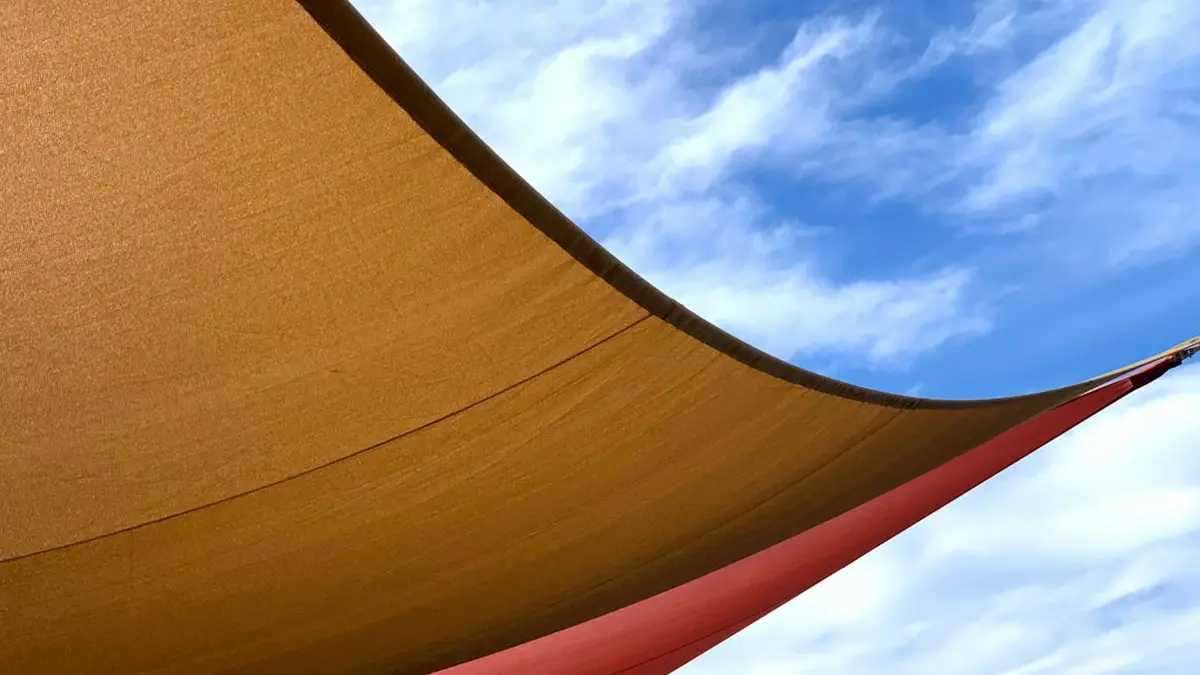
Choose a shade sail for the most shaded area per dollar where rain cover does not matter. Choose a retractable awning for full shade against one wall on calm days, or a pergola for a permanent structure that needs a fabric or louvered top to give full shade.
The choice depends on three things:
- whether the structure keeps out rain
- how many years it lasts before replacement
- whether it needs a building permit in the US or planning permission in the UK
The figures below come from installers, retailers and review sites unless a government source is named. Each price is the figure the source published.
The three in figures
| Specification | Shade sail | Retractable awning | Pergola (open-beam) |
|---|---|---|---|
| Installed price, Pergola Cave | $200 to $2,000 | $2,000 to $8,000 | $3,000 to $15,000 |
| Product price, BackyardRanked 2026 | Under $65 for a 16 x 20 ft (4.9 x 6.1 m) SUNLAX sail | $800 to $3,000 for a 16 x 10 ft (4.9 x 3.0 m) model | $500 to $3,000 by size and material |
| Lifespan, Pergola Cave | 3 to 5 years | 5 to 8 years | 15 to 25 years |
| Sun or UV blocked | 85 to 98% UV block (Pergola Cave) | 100% UV protection (BackyardRanked) | 30 to 50% shade (BackyardRanked) |
| Rain protection | None (Pergola Cave) | Light rain resistance (BackyardRanked) | None (BackyardRanked) |
No source gives a wind rating for all three structures. Wind limits are covered in each product section.
Shade sail
A shade sail covers a large or irregular area for the lowest cost of the three. BackyardRanked lists a 16 x 20 ft (4.9 x 6.1 m) SUNLAX sail at under $65. That sail covers 320 sq ft (29.7 sq m). BackyardRanked says shade sails are the option that "covers most square footage per dollar". Pergola Cave gives an installed range of $200 to $2,000.
UV block depends on how dense the fabric is. Pergola Cave gives 85 to 98%. BackyardRanked gives 90 to 95% for HDPE fabric, which still lets air through.
Pergola Cave states that a sail can be installed in an afternoon without a permit. NicheValidation states that a sail needs correct anchor geometry and sometimes new posts. The sail must be hung at a slope so that water does not pool on it.
The two limits are rain and lifespan:
- Rain: a mesh sail gives no rain protection.
- Lifespan: Pergola Cave gives 3 to 5 years. BackyardRanked states that sails degrade from UV within 5 to 8 years.
- Cost over 10 years: Pergola Cave puts this at $2,400 to $3,300. The figure includes replacement fabric and the labor to rehang it.
Commercial-grade sails last longer. Versatile Structures, an Australian installer, states that they last 10 to 20 years with annual inspection and cleaning. Its prices are for commercial work and do not compare with the residential figures above.
The fabric comparer sets the main outdoor shade fabrics side by side.
Buy a shade sail if the area is large or irregular, the budget is under $2,000 and the space does not need to stay dry.
Retractable awning
A retractable awning opens only when shade is needed. It folds back against the wall when it is not in use. BackyardRanked says it gives "100% UV protection plus light rain resistance". It is the only one of the three that the sources credit with any rain protection without an added cover.
Published prices:
- Pergola Cave: $2,000 to $8,000 installed.
- BackyardRanked: $800 to $3,000 for a 16 x 10 ft (4.9 x 3.0 m) awning covering 160 sq ft (14.9 sq m).
- CostToRenovate: about $6,100 for a premium motorized install. This source does not separate sails from awnings.
Published limits:
- Wind: Pergola Cave limits retractable awnings to winds of 20 to 25 mph.
- Storms: NicheValidation states that the awning must be retracted in bad weather.
- Wear: the mechanical parts can degrade over time (NicheValidation).
- Width: the wall the awning is mounted on sets its maximum width (NicheValidation).
- Lifespan: Pergola Cave gives 5 to 8 years.
The fabric sets much of the lifespan. CostToRenovate gives 10 to 15 years for solution-dyed acrylic and 3 to 5 years for polyester. BackyardRanked gives 10 years or more for acrylic. It gives 3 to 5 years for polyester before significant fading.
Buy a retractable awning if the shade is needed against one wall, not all day, at a site that is seldom windy.
Pergola
A pergola is the permanent option. Pergola Cave gives $3,000 to $15,000 installed for a traditional lattice or open-beam pergola, with a lifespan of 15 to 25 years. BackyardRanked gives $500 to $3,000 for pergola structures, depending on size and material. It gives a lifespan of 15 to 25 years for cedar with occasional sealing.
An open-beam roof filters sun but does not block it. BackyardRanked states that a pergola gives 30 to 50% shade, depending on sun angle, and no rain protection. NicheValidation states that a pergola needs added fabric for full sun and rain protection. Its footprint is fixed and cannot be adjusted.
A pergola can carry loads that the other two cannot. BackyardRanked states that pergolas can support climbing plants up to 150 lb (68 kg). NicheValidation states that pergolas can carry lighting. It describes them as extremely durable, with high wind resistance. No source gives a wind rating in mph for an open pergola.
A louvered roof adds shade and rain cover at a higher price. Pergola Cave gives:
- Fixed louvered pergola: $4,000 to $12,000. This is 30 to 50% less than a motorized one.
- Motorized louvered pergola: $12,000 to $60,000 or more. It lasts 25 to 40 years or more.
The louver angle calculator gives the louver setting that blocks the sun at a given hour.
Buy a pergola if the structure is meant to stay for 15 years or more. Budget for a fabric or louvered top if full shade or rain cover is needed.
Rain cover and ten-year cost
Rain. A mesh shade sail keeps out no rain. An open pergola keeps out no rain. A retractable awning resists light rain only. In these sources, full rain cover comes only from a louvered pergola or a solid-roof patio cover. Pergola Cave gives a solid-roof patio cover at $8,000 to $25,000, with a lifespan of 30 to 40 years or more.
Cost over time. The structure that costs least to buy does not cost least to keep. Pergola Cave puts the 10-year cost of a shade sail at $2,400 to $3,300 because the fabric is replaced and rehung within that period. It puts a louvered pergola at $20,000 to $20,200 over the same 10 years. These are Pergola Cave's own estimates. It gives no 10-year figure for a retractable awning or an open pergola.
An awning with a 5 to 8 year lifespan will need at least one fabric or unit replacement within 10 years. The sources do not give a price for that replacement.
Permits: US building codes and UK planning
United States. No single national rule covers all three structures. PermitsGuide states that IRC Section R105.2 exempts one-story detached accessory structures up to 200 sq ft (18.6 sq m). This is a model-code baseline. Cities change it:
- Houston: 120 sq ft (11.1 sq m) from January 1, 2024 (PermitsGuide Texas).
- San Diego: patio covers up to 300 sq ft (27.9 sq m) of projected roof area on single-family and duplex lots. The cover must be open on two or more sides, one story, and no taller than 12 ft (3.7 m) (City of San Diego, Information Bulletin 206).
- Seattle: a 12 x 12 ft (3.7 x 3.7 m) pergola covers 144 sq ft (13.4 sq m). That already exceeds the local exemption (BlueFiks Pros).
Three conditions require a permit regardless of size:
- If the structure is attached to the house, a permit is required in nearly all jurisdictions.
- If the top is solid, louvered or covered in fabric, PermitsGuide states it is treated as a patio cover under IRC Appendix H. A patio cover needs a permit almost everywhere.
- If lights, fans or heaters are added, a separate electrical permit is required.
Setbacks apply even when no building permit is needed. BlueFiks Pros gives typical setbacks of 3 to 5 ft (0.9 to 1.5 m) from property lines.
Pergola Cave states that a shade sail needs no permit. Freedom Room states that buried posts or concrete footings make a pergola a permanent improvement, which triggers review. The sources do not say whether building departments apply this rule to sail posts. None of the sources covers permits for retractable awnings. Check with the local building department before buying one.
United Kingdom (England). The Planning Portal classes a pergola as permitted development in most cases. Planning Geek and Signature Pergolas set out the Class E conditions:
- The pergola cannot sit on the principal elevation, which is the side facing the road.
- Within 2 m (6.6 ft) of a boundary, the whole structure must be no taller than 2.5 m (8.2 ft).
- More than 2 m from a boundary, a flat or louvered roof may reach 3 m (9.8 ft). A dual-pitched roof may reach 4 m (13.1 ft).
- Eaves may not exceed 2.5 m (8.2 ft).
- A raised platform may not exceed 0.3 m (about 1 ft).
- All outbuildings together may not cover more than 50% of the garden area, excluding the original house.
Signature Pergolas states that open-sided structures under 30 sq m (323 sq ft) typically do not need Building Regulations approval. It also states that enclosing a wall-mounted pergola with solid walls or permanent glazing can reclassify it as an extension.
Squote states that tensile shade sails are "generally not development". None of the sources covers planning rules for awnings. Contact the local planning authority before fitting one.
Which to choose
- If the budget is under $2,000, the area is large or irregular and rain does not matter, buy a shade sail. Plan to replace the fabric within 3 to 8 years.
- If shade is needed against one wall for part of the day, the site is seldom windy and light rain cover is useful, buy a retractable awning. Choose solution-dyed acrylic fabric over polyester, because the sources give it 10 years or more against 3 to 5.
- If the structure must last 15 years or more, or must carry plants or lights, buy a pergola. If it needs more than 30 to 50% shade, add a fabric or louvered top. In the US, adding that top usually means a permit is required.
- If the space must stay dry, none of the three does this without an added cover. The sources give a fixed louvered pergola from $4,000 and a solid-roof patio cover from $8,000.
Comments
No comments yet. Be the first to comment!
Leave a Comment