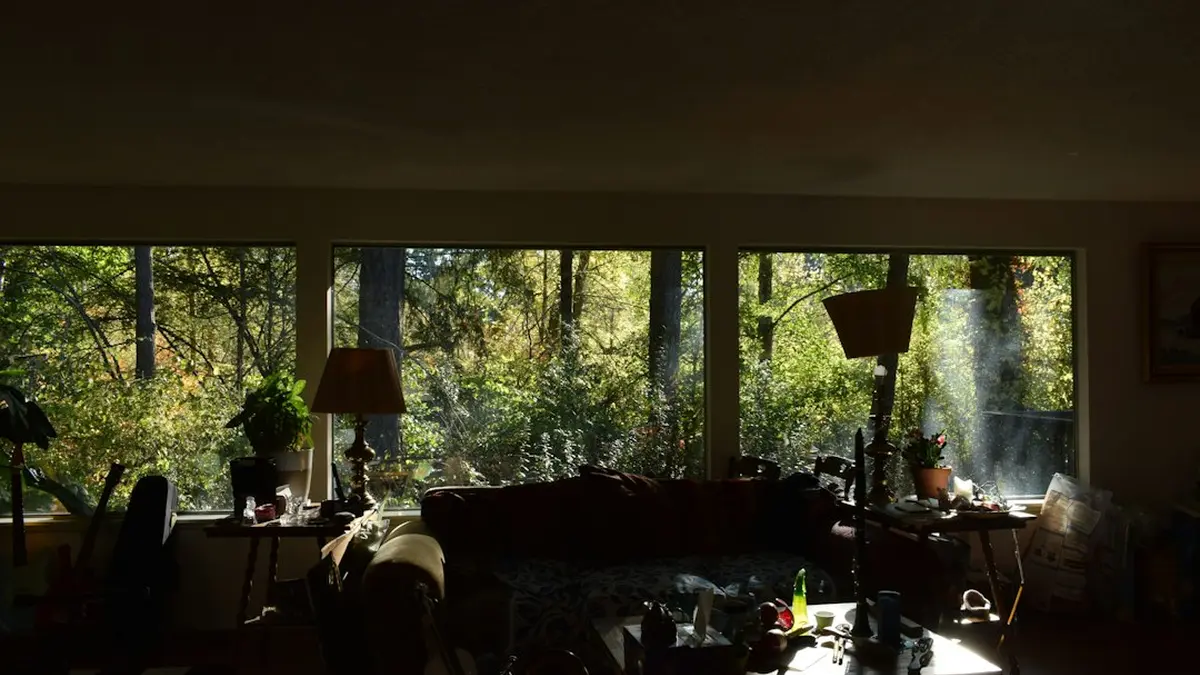
At the December 21, 2026 solstice, the noon sun stands about 26.6 degrees above the horizon at 40°N, the latitude of Sacramento and Philadelphia. In London, at 51.5°N, it stands about 15.1 degrees up. At 56°N, the latitude of central Scotland, it reaches only about 10.6 degrees. This page is for US and UK homeowners whose south-facing windows, patio doors or patios now take in low, direct sun that a summer awning or overhang used to block. It shows how to work out the winter sun angle for your own latitude, how far that sun reaches into a room, and what controls it.
The most common mistake is to blame the clock change. US clocks fell back on November 1, 2026 and UK clocks on October 25, 2026. A clock change does not move the sun. It moves the clock time at which each sun angle happens. The sun has been getting lower at noon every day since the June solstice, and it keeps getting lower until December 21.
How the winter sun angle is worked out
The height of the sun above the horizon is called its altitude or elevation. It is measured in degrees, from 0 at the horizon to 90 straight overhead. The compass direction of the sun is called its azimuth. It is measured clockwise from true north.
Two things set the sun's noon altitude:
- Latitude. This is how far north of the equator you are.
- Solar declination. This is how far north or south of the equator the sun is overhead on a given date. Earth's axial tilt of about 23.4 degrees sets its range. It runs from about +23.45 degrees at the June solstice to about -23.45 degrees at the December solstice, according to Studio Matrx's October 2026 article on sun angles.
The full method
NOAA's Global Monitoring Laboratory publishes the equations behind its Solar Calculator in a two-page document, Solar Calculation Details, written by Chris Cornwall and dated March 7, 2017. The method is derived from Jean Meeus's Astronomical Algorithms. It runs in this order:
- A fractional year (gamma), in radians, is calculated from the day of the year and the hour.
- The equation of time (in minutes) and the solar declination are estimated from gamma with trigonometric series.
- Solar noon, in minutes after midnight UTC, is 720 minus 4 times the longitude minus the equation of time. Longitude is positive east of the Prime Meridian.
- The zenith angle comes from: cos(zenith) = sin(latitude) x sin(declination) + cos(latitude) x cos(declination) x cos(hour angle).
- Altitude is 90 degrees minus the zenith angle.
- Azimuth comes from an arccos expression. It needs a quadrant correction depending on whether the time is before or after solar noon.
For sunrise and sunset, NOAA sets the zenith angle to 90.833 degrees. The extra 0.833 degrees allows for atmospheric refraction and the size of the sun's disk.
The noon shortcut
At solar noon, the NOAA document gives a shortcut for Northern Hemisphere sites:
Noon altitude = 90 - |latitude - declination|
At the December solstice the declination is about -23.45 degrees. For any US or UK latitude, the shortcut then becomes:
Winter solstice noon altitude = 90 - latitude - 23.45
CalcTune states the same winter formula and gives 26.6 degrees at 40°N. Everycalculators gives about 15.1 degrees for London at 51.5°N. A worked example cited by Harvesting Rainwater gives about 10.6 degrees at 56°N. All three match the shortcut.
At solar noon in winter, the sun is due south (azimuth 180 degrees) for every US and UK site. Sunrise and sunset fall south of due east and due west at the winter solstice, according to CalcTune.
| Latitude | Dec 21 noon altitude | Jun 21 noon altitude | Winter shadow length (x object height) |
|---|---|---|---|
| 30°N | 36.6° | 83.5° | 1.3 |
| 35°N | 31.6° | 78.5° | 1.6 |
| 40°N (Sacramento, Philadelphia); 26.6° per CalcTune | 26.6° | 73.5° | 2.0 |
| 45°N | 21.6° | 68.5° | 2.5 |
| 50°N | 16.6° | 63.5° | 3.4 |
| 51.5°N (London); 15.1° per Everycalculators | 15.1° | 62.1° | 3.7 |
| 55°N | 11.6° | 58.5° | 4.8 |
| 56°N (central Scotland); 10.6° per Harvesting Rainwater | 10.6° | 57.5° | 5.4 |
The table applies the NOAA noon shortcut with declinations of -23.45 and +23.45 degrees. Shadow length is 1 divided by the tangent of the winter altitude. Figures are rounded to one decimal place. They ignore atmospheric refraction, so NOAA's calculator may return values that differ slightly.
The difference between the two altitude columns is about 46.9 degrees at every latitude. Studio Matrx gives the same figure: twice the 23.45-degree declination.
Finding the angle for your window, step by step
-
Your latitude and longitude
From a map app or by dropping a pin in NOAA's Solar Calculator.
-
The direction the window or patio faces
A phone compass works. Correct to true north if the app shows magnetic north.
-
A tape measure
For the height of the top of the glass above the floor, and the depth of any overhang or awning.
-
The dates you care about
Today, December 21, and any date you plan to sit out or use the room.
-
Confirm which way the window faces
Take a compass reading standing with your back to the glass. The garden aspect finder does this with a phone compass or with the sun.
If the reading is between southeast and southwest, the window takes the low winter noon sun head on. If it faces east or west, it takes low sun in the morning or afternoon instead.
-
Calculate the solstice noon altitude
Subtract your latitude and 23.45 from 90. At 40°N this is 90 - 40 - 23.45 = 26.55, about 26.6 degrees. At 51.5°N it is 15.05, about 15.1 degrees.
This is the lowest noon altitude of the year at your site. Every other day of the year, the noon sun is higher.
-
Check it against NOAA's calculator
Open the NOAA Solar Calculator. Enter your latitude and longitude. Set the time zone by hand: NOAA warns that auto-detect may be unreliable for future dates. Enter December 21, 2026 and the solar noon time the calculator shows.
If it worked, the elevation output will be within about 1 degree of your step 2 figure. The calculator also returns declination, equation of time, solar noon, sunrise, sunset and azimuth.
-
Find today's angle as well
Repeat step 3 with today's date. The sources used here do not list an early-November declination, so take it from the calculator rather than from a table. In early November the noon altitude is between its equinox value (about 90 minus latitude) and its solstice low.
-
Find the clock times of the glare
Read the solar noon time from the calculator. After the clocks fall back, solar noon is about one hour earlier on the clock than it was in summer.
The sun is lower at every other time of day than at noon. Run the calculator for the hours the room is in use, for example the late afternoon. If the elevation is below about 15 degrees and the azimuth is within the arc the window faces, expect direct sun at eye height.
-
Measure how far the sun reaches into the room
Measure the height of the top of the glass above the floor. Divide it by the tangent of the sun's altitude. The result is how far from the window the sun lands on the floor. See the worked example below.
-
Check the overhang or awning against the winter angle
A fixed overhang or awning sized for summer is meant to let the winter sun under it. If the room now gets sun where it did not in summer, the overhang is doing its job. Do not extend it to block winter sun without checking the summer case: the awning size and projection calculator works out projection and pitch for both seasons.
-
Choose a control for the hours that matter
Use the clock times from step 5 to choose what to fit. The options are set out in the next section of this step: adjustable blinds, interior shades, or exterior shade adjusted for winter. The sources used here do not give product prices.
How far the noon sun reaches into a room on December 21
A hypothetical south-facing room has glass whose top edge is 7 ft (2.1 m) above the floor. Nothing outside shades it. Sun depth on the floor = glass height / tan(altitude).
| 40°N: altitude 26.6°, tan = 0.50 | 7 ft / 0.50 = 14.0 ft (4.3 m) |
|---|---|
| 51.5°N (London): altitude 15.1°, tan = 0.27 | 7 ft / 0.27 = 25.9 ft (7.9 m) |
| 56°N: altitude 10.6°, tan = 0.19 | 7 ft / 0.19 = 37.6 ft (11.5 m) |
At noon on the solstice, direct sun reaches about 14 ft (4.3 m) into the room at 40°N and about 26 ft (7.9 m) in London. At 56°N it would reach about 38 ft (11.5 m), which is deeper than most rooms. In practice it lands on the back wall at standing and seated eye height.
Controls for low winter sun
Low winter sun has two effects. It brings in passive solar warmth, which is the reason winter-sun design patterns such as the one in Rainwater Harvesting for Drylands and Beyond aim to keep it. It also causes glare, fades fabric and floors, and washes out TV and computer screens. The controls below keep some of the first and cut the second.
- Adjustable horizontal blinds. Tilting the slats upward sends the low beam toward the ceiling. The room keeps light and some heat. The direct beam no longer reaches eye height or screens.
- Interior shades lowered for set hours. Use the clock times from step 5. Lower the shade only for the glare hours and raise it the rest of the day.
- A retractable awning, retracted. In winter a retracted awning lets the full sun in. Whether to retract or leave it out over winter is covered in retractable vs fixed awnings.
- A shade sail or awning pitched for winter sun. To block a 15-degree sun from outside, a sail must hang low and close to the line of sight. That also blocks the view and the warmth. Model the shadow before buying or moving anything.
Where it goes wrong
Using the equinox formula for winter. The formula altitude = 90 - latitude applies only at the equinoxes. Studio Matrx notes that it ignores the seasonal declination and is inaccurate for solstice design work. How to recognize it: your winter figure at 40°N comes out at 50 degrees instead of about 26.6. What to do: subtract the extra 23.45 degrees for December 21.
Getting the units or signs wrong. The NOAA document works in radians for its intermediate steps. Its longitude is positive east. Some derived implementations use other sign conventions. How to recognize it: solar noon is hours away from 12:00 local standard time, or an altitude is negative at midday. What to do: check whether your formula or spreadsheet expects degrees or radians, and whether west longitudes are entered as negative.
Trusting the time zone auto-detect. NOAA's calculator warns that auto-detect may be unreliable for future dates and locations. How to recognize it: the solar noon time shown is an hour off from what you expect. What to do: set the time zone by hand.
Treating the calculator as guaranteed. NOAA states that the calculator is "no longer actively supported or maintained" and that results are "for research and entertainment only." NOAA also notes that the observed sun position may differ from the calculated one because of atmospheric refraction and algorithm uncertainty. What to do: treat the result as accurate to within a degree or so, and leave a margin when sizing anything fixed.
Assuming June shade works in December. The noon sun is about 46.9 degrees lower at the December solstice than at the June solstice at every latitude. Studio Matrx notes that a structure that shades a patio correctly in June can under-shade or over-shade it in December. What to do: run the shadow for both solstices before building.
Blaming the clock change. If the sun seems suddenly lower after the clocks change, the cause is the clock. A given clock time in the afternoon now falls one hour later in the solar day than it did before the change. The sun is lower at that moment because it is closer to sunset, not because the sun moved.
When the answer changes
Latitude. The noon altitude falls by 1 degree for every degree north. On December 21 the gap between 30°N and 56°N is 26 degrees of altitude. The shadow of a 1 ft (0.3 m) post is about 1.3 ft (0.4 m) long at 30°N and about 5.4 ft (1.6 m) long at 56°N.
Time of day. The noon figure is the highest the sun gets that day. At any other time it is lower. Glare through west windows in the late afternoon comes from a sun lower than the noon figure.
Which way the window faces. At the winter solstice the sun rises south of east and sets south of west. A window facing southeast or southwest gets low sun for longer than one facing due east or west. A north-facing window in the US or UK gets no direct winter sun at noon.
Date. The solstice is the lowest point. Before December 21 the noon sun is a little higher each day back toward November. After December 21 it rises again. Dates close to the solstice give nearly the same noon altitude, because the declination changes slowly there.
The exact moment of the solstice. Three sources (timeanddate.com, Star Walk and Universal Time Date) give 20:50 UTC on Monday, December 21, 2026. That is 3:50 pm EST, 12:50 pm PST and 8:50 pm GMT. EarthSky gives 20:30 UTC. Farmers' Almanac gives 10:50 am EST (15:50 UTC), which differs from the others by about 5 hours and should be checked against NOAA or the US Naval Observatory. For a noon-altitude calculation the difference does not matter, because the declination barely changes over those hours.
US and UK clocks. US clocks fell back on November 1, 2026 and UK clocks on October 25, 2026. Between those two dates the UK was on GMT and the US was still on daylight time. In December the UK is on GMT, which equals UTC, so NOAA's UTC solar noon converts with no offset.
What the figures mean in practice
The sources used here give no prices for blinds, shades, awnings or sails. They also give no measured figure for the heating value of winter sun through a window. Neither can be stated from them.
What the figures do support:
- At 40°N, winter noon sun can reach about twice the height of the glass into a room. In London it can reach nearly four times. At 56°N it can reach more than five times.
- An overhang that blocks a June noon sun of 62 to 74 degrees at these latitudes will not block a December sun of 11 to 27 degrees. That is the intended behavior of a summer overhang.
- Any control aimed at winter glare needs to work at the low angle of the hours you use the room, not at noon alone.
For the summer side of the same window, including measured savings from exterior and interior shading, see shading windows to cut cooling costs.
Comments
No comments yet. Be the first to comment!
Leave a Comment